The April birthstone is the hardest natural material on earth. Diamond scores a 10 on the Mohs hardness scale, hitting the ceiling of the entire rating system. Nothing can scratch it except another diamond. That singular fact has shaped how the stone has been understood across every culture that has encountered it: as something permanent, something that endures when everything softer wears away.
The April birthstone carries more cultural weight than almost any other stone in the birthstone calendar. Some of that weight is earned, some has been manufactured by a century of marketing that turned a mineral into a social obligation. This guide covers what a diamond actually is, what it has meant across history, and how to wear it with intention rather than convention.

Diamond Birthstone
Diamond is a form of carbon crystallized under extreme heat and pressure deep within the Earth's mantle, typically between 140 and 190 kilometres below the surface. It rises to the surface through volcanic activity, carried upward in formations called kimberlite pipes over millions of years.
The result is a stone with a crystal structure so tightly bonded that it becomes the hardest substance found in nature. That structure also gives diamond its optical properties: the ability to bend and disperse light into its spectral components, producing the fire and brilliance the stone is known for.
Diamond has been the designated birthstone for April since the standardization of the modern birthstone list in 1912, though its association with April and with enduring commitment stretches back considerably further in both Eastern and Western traditions.
Diamond Birthstone Meaning & History
The April birthstone meaning is built on two foundations: invincibility and clarity.
The word diamond comes from the Greek adamas, meaning "unconquerable" or "indestructible". Ancient Greeks believed diamonds were fragments of fallen stars, or the tears of the gods. Ancient Romans thought they were splinters of the tips of Cupid's arrows, which may partly explain how the stone became so thoroughly embedded in romantic tradition centuries later.
In Indian tradition, diamonds were associated with the god Indra and carried protective qualities. Warriors wore them in battle. Hindu texts classified diamonds by their qualities: clarity, colour, and structural integrity, each of which carried a distinct symbolic meaning.
Medieval Europe associated diamonds with courage and moral clarity. Kings wore diamonds not as decoration but as armour, believing the stone made its wearer invulnerable to fear, poison, and enemy attack. The instinct behind that belief was straightforward: choose the hardest thing you can find and keep it close. Over time, that meaning morphed into modern symbolism: commitment, loyalty, permanence. Something that lasts because it’s built to.
The April birthstone meaning in contemporary terms reflects what has always been true of the stone: the willingness to commit to something without hedging and clarity about what matters and what doesn't. Diamond’s permanence is unquestionable and doesn’t require a marketing campaign to validate.
Where Is Diamond Found?
Diamonds form in the Earth's mantle and are brought to the surface through kimberlite and lamproite volcanic pipes. The major producing countries today are Russia, Botswana, Canada, Australia, and the Democratic Republic of Congo, with Russia and Botswana accounting for the majority of global production by volume and value. No matter their geographic origin, each natural diamond mined comes from a process that takes thousands of years.
South Africa dominated world production from the late 19th century through much of the 20th century and still contributes significant output, particularly from the historic Kimberley and Cullinan mines. Namibia produces diamonds of exceptional quality through marine and coastal deposits. Zimbabwe, Angola, and Sierra Leone also contribute to the African supply.
Canada entered the market seriously in the 1990s with the opening of the Northwest Territories mines, producing stones with strong provenance documentation, which has become increasingly relevant to buyers who want to know the full chain of custody behind what they wear.
Diamond Birthstone Colour & Varieties
When people ask what colour the April birthstone is, the immediate answer is white or colourless, the most commercially familiar version. The fuller answer is more interesting.
Diamond occurs across a wide colour spectrum. The grading system for colourless diamonds runs from D (completely colourless) through Z (light yellow or brown tint). Within that range, the differences are subtle and require controlled lighting conditions to detect accurately. D through F grades are considered colourless. G through J are near-colourless. K and below carry visible warmth.
Beyond the colourless range, diamonds occur in what the trade calls “fancy colours”: yellow, brown, blue, green, pink, orange, red, and black. These colours are caused by structural anomalies or trace elements inclusions during formation. Yellow and brown fancy diamonds are the most common. Blue diamonds contain boron. Green diamonds have been exposed to natural radiation during formation. Red and pink diamonds remain among the rarest materials on earth.
Black diamond, which is actually a polycrystalline form called carbonado, has a different character entirely. Opaque, dense, and matte rather than brilliant, it sits closer to bloodstone in its visual register than to a traditional colourless gem. For jewelry that values depth over display, a black diamond carries a distinct presence. Their surface absorbs light rather than dispersing it, which gives black diamonds a grounded quality that reads differently on the body than traditional clear diamonds.
Diamond Birthstone Care & Cleaning
Diamonds are the most durable option in the birthstone calendar, but durability is not the same thing as indestructibility. Diamond can chip along its cleavage planes if struck at the right angle with sufficient force. The hardness prevents surface scratching, but the crystal structure can fracture under sharp impact.
Cleaning diamonds is straightforward: just use warm water, mild soap, and a soft brush. Ultrasonic cleaners are generally safe for diamonds without significant inclusions, but use caution on heavily included stones or settings with multiple components. Steam cleaning is effective for colourless diamonds in secure settings.
Store diamonds separately from other jewelry. Their hardness means they can scratch everything around them. Keep settings clean, particularly around prongs, to maintain secure stone placement over time. Sterling silver settings should be polished periodically. The stone holds its character best when the setting around it is maintained with the same care and attention.

Diamond Jewelry: Rings, Necklaces & Gifts
April Birthstone Ring
The April birthstone ring carries the most cultural history of any jewelry in this series. A diamond ring’s association with commitment and permanence carries meaning that extends beyond the stone itself. In design terms, the stone performs across settings from minimal tension and bezel formats to more structured prong and channel settings. Cut matters as much as carat: a well-cut stone of modest size reads more clearly than a larger stone with poor geometry.
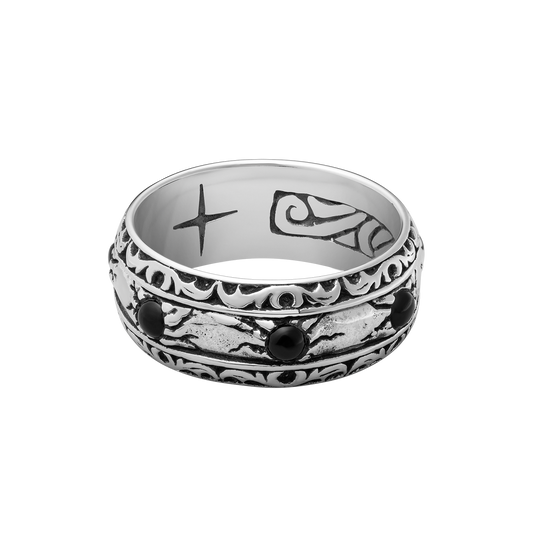
For men's designs, bezel and flush settings in sterling silver or stainless steel let the stone carry weight without requiring traditional ring architecture. Black diamond in particular works well in formats that borrow from signet and band traditions.
April Birthstone Necklace
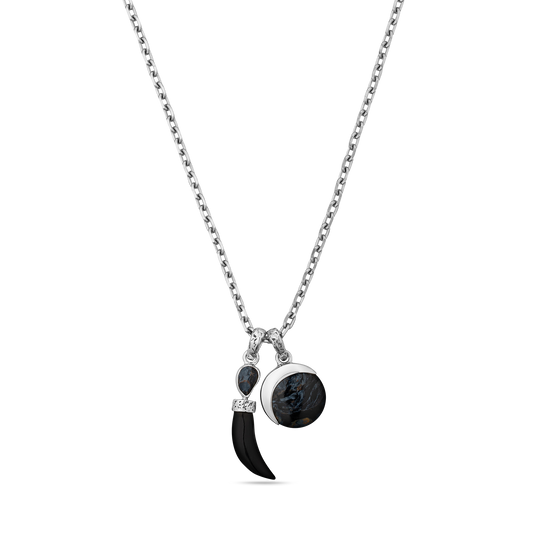
An April birthstone necklace works best when the stone is the focal point, and the chain is chosen to support rather than compete. Solitaire pendant styles let a single stone carry the composition. For colourless diamonds, silver chain weights that keep proportions clean work well. For black diamonds, heavier chains with oxidized finishes balance the stone's tone more naturally.
April Birthstone Bracelet
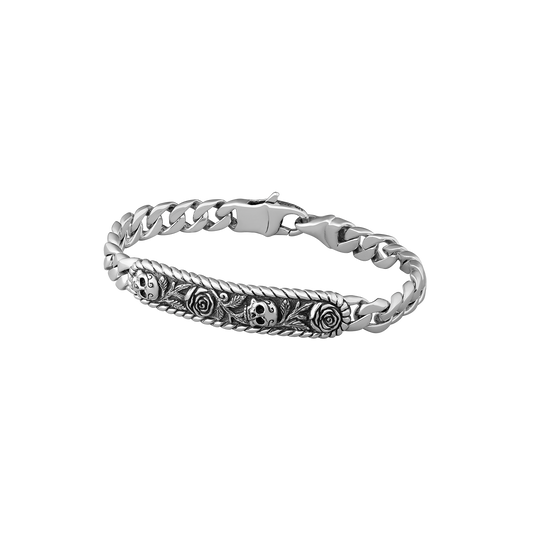
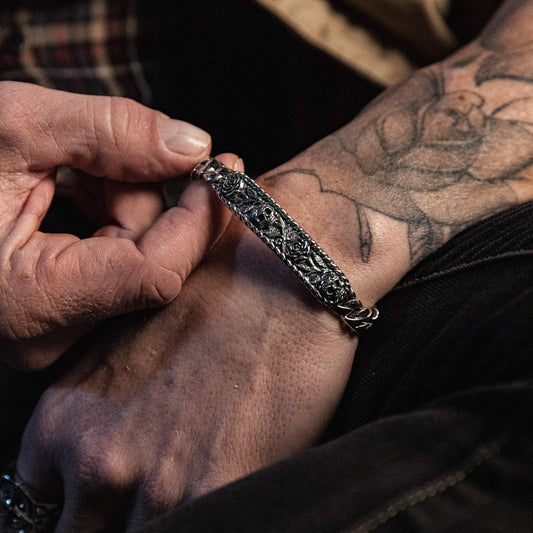
A diamond in a bracelet distributes the stone's presence across the wrist rather than concentrating it. Channel-set formats work well for colourless diamonds. Bezel-set black diamond accents integrated into link or cuff designs carry the stone's character without requiring the piece to be built entirely around it.
April Birthstone Earrings
April birthstone earrings in diamond stud styles are among the most enduring jewelry configurations in any tradition. A well-cut stone in a stud reads clearly at close range. For those who prefer less conventional styles, diamond accents in hoop or drop design add presence without making the stone the entire conversation.
If you’re considering an April birthstone gift, keep the focus on intention. A well-chosen piece will fit into daily life, complementing all of one’s daily activities rather than demanding special attention.
April Birthstone by Date of Birth
As the April birthstone, diamonds cover the full month without division. Some modern interpretations draw distinctions by diamond colour or cut characteristic across dates within April, mapping the stone's variety to different symbolic emphases.
|
Dates |
Diamond Variety |
Colour Profile |
Symbolic Tone |
|
Apr 1, 6, 11, 16, 21, 26 |
Colourless Diamond |
D-F, Pure White |
Clarity & Permanence |
|
Apr 2, 7, 12, 17, 22, 27 |
Near-Colourless Diamond |
G-J, Warm White |
Conviction & Depth |
|
Apr 3, 8, 13, 18, 23, 28 |
Fancy Yellow Diamond |
Canary to Deep Yellow |
Instinct & Energy |
|
Apr 4, 9, 14, 19, 24, 29 |
Black Diamond |
Opaque Black |
Groundedness & Resilience |
|
Apr 5, 10, 15, 20, 25, 30 |
Fancy Blue Diamond |
Light to Deep Blue |
Composure & Integrity |
Regardless of variety, diamonds are the birthstone for the entire month of April. The distinctions above reflect the stone's natural range rather than separate designations.
Alternative April Stones: White Sapphire, White Topaz & Moissanite
Not everyone connects with diamonds in the same way. Thankfully, there are alternative April birthstones that carry a similar visual clarity with different characteristics.
White Sapphire
White sapphire is a colourless variety of corundum, ranking 9 on the Mohs hardness scale. It's the closest alternative to diamond in terms of durability and shares the same mineral family as ruby and blue sapphire. Sapphire’s optical properties produce less fire and brilliance than diamond, but carry a clean, composed presence that works well in silver settings. Durable enough for everyday wear, sapphire holds its own well in pieces without dominating.

White Topaz
White topaz ranks 8 on the Mohs scale and is significantly more affordable than diamond or sapphire. Topaz is colourless in its pure form and carries reasonable brilliance in well-cut specimens. The stone scratches more readily than sapphire and will show surface wear over time with daily use. White topaz carries brightness, but with a lighter feel. More economically accessible, Topaz is often used in April birthstone jewelry as a diamond alternative that holds similar visual clarity with a significantly lower price point.
Moissanite
Moissanite is a silicon carbide compound that occurs naturally in minute quantities but is produced synthetically for jewelry use. It ranks 9.25 on the Mohs scale, harder than sapphire and close to diamond. Its optical properties produce more fire than diamond, meaning more spectral dispersion of light, which reads as sharp, rainbow-like flashes in bright conditions. Structurally, moissanite is a serious material. Sharper flashes, more movement. It wears exceptionally well and is worth choosing for what it is, not as a stand-in for something else.
Ways to Wear Your April Birthstone
How you wear the April birthstone matters as much as the piece itself. The real weight of a diamond has nothing to do with status. It's about choosing something permanent and wearing it without needing to explain the choice.
Colourless diamond pairs cleanly with sterling silver and white metals, where the stone's brilliance reads against the setting without either element pulling focus. Yellow gold introduces warmth and contrast. Black diamond pairs most naturally with oxidized silver, stainless steel, and darker metalwork, where the stone's opacity and the setting's weight feel proportionally matched.
For daily wear, proportion matters more than size. A well-cut stone in a secure, clean setting reads with more character than a larger stone in a heavy, overstated format. The stone doesn't need help announcing itself. A ring holds meaning. A chain keeps things closer. A bracelet builds consistency over time.
Layering diamonds with other stones from the birthstone calendar works when the metals are consistent, and the pieces are worn with intention rather than accumulation. A black diamond ring alongside garnet or bloodstone carries a visual logic. Colourless diamond with aquamarine creates a tonal contrast that holds without competing.
Where to Buy or Explore More Birthstones
If you’re looking to explore April birthstone jewelry, focus on materials that suit the nature of the stone. Sterling silver and stainless steel both provide a solid foundation that doesn’t compete with the diamond itself. The piece should feel complete on its own.
For colourless stones, look for cuts that allow light through the stone fully; round brilliant, princess, and cushion cuts all perform well in this regard. For black diamond, cut matters less than setting security, since the stone's value is in its surface presence rather than its optical performance.
The birthstone sequence that surrounds April is worth noting. March carries aquamarine and bloodstone, both grounded and directional. May brings emerald, the first deeply saturated colour stone in the spring sequence. April holds the position between them with something that reflects everything and commits to nothing in terms of colour.
Final Thoughts: Why Diamond Endures as April's Birthstone
The April birthstone has endured not because of marketing, though there has been plenty of it, but because the stone's actual properties have always aligned with what the designation requires: permanence and clarity. The hardest thing in the room, worn without needing to announce it.
What is the birthstone for April? Diamond. The answer has remained the same for centuries, across cultures that had no contact with each other but arrived at the same stone for the same reasons. Whether you wear it colourless and brilliant or black and grounded, the primary character stays consistent. Diamond is the April birthstone because it stays consistent: clear in what it is, and steady in how it’s worn.